Monday, August 8, 2016

Our Birthday Adventure

 
Saturday night, our family and some close friends had dinner at a restaurant on City Island in the Bronx that is steeped in family history, though I don’t believe my children had ever been there before. Everyone enjoyed their meals, but we weren’t really there for the food. We were there for the history. We were celebrating a new moment in family history—my son’s 35th birthday—while recalling wonderful stories about Audrey’s mother (my children’s grandmother), who had died eight years ago but seemed very much alive on City Island this night.   

The Lobster Box is located near the tip of City Island, an incongruous seaside locale in the middle of New York, jutting out into Long Island Sound. Getting there can be an adventure by car, by train, or by bus. It is not on the beaten track. But the getting there is all part of the restaurant’s history and appeal for our family. My mother-in-law loved the Lobster Box and especially the adventure of getting there. She would come at least once each summer, accompanied by her cousin Lisa, and the cousins kept coming well into their 90s.
City Island isn't on the beaten track.
They were hardy and stubborn women who didn’t let advancing years persuade them to make the trip in an easier, less adventurous way. Neither woman believed in taxis or subways. Taxis were a waste of money, and subways required negotiating steps down and up. They insisted on public transportation that traveled at ground level, which meant buses. And there was no single bus that could take either woman from her home in upper Manhattan or in Riverdale in the Bronx. No, they would have to transfer once or twice to reach City Island. The trip could take almost three hours each way, but that was all part of the plan. They would each start out around noon in order to meet up and arrive at the Lobster Box before three in the afternoon. The timing was very important. The restaurant served from its lunch menu until three, and charged lunch prices for its large servings. After three, the dinner menu prices would take effect. The same seafood dinner could cost almost twice as much, which seemed both outrageous and extravagant to the two women.
Some people drive and park at the Lobster Box;
others are more adventurous.
After they finished their meals, they would walk to the nearby parking area that looked over the Sound and enjoy the view. Then they would start the return trip. It might take three hours again, but they weren’t in any hurry. They had set aside the entire afternoon for dining, visiting, and traveling to the seaside.

As you can imagine, stories of these time-consuming and economizing adventures took on a life of their own and especially amused my children, though I cannot, for the life of me, remember why we had never gone as a family with my mother-in-law to the Lobster Box. I know that Audrey and I went at least once with the two cousins, driving them and arriving at the dinner hour. (We were willing to bear the extravagance.) And I remember going once with my mother-in-law when Audrey and the children were away during a summer weekend. That time, she insisted on treating, and also insisted on our arriving before three. But why had we never taken the children there while my mother-in-law and her cousin were still alive? I wasn’t even sure that my kids remembered the stories about the place until Brett insisted that the Lobster Box was where he wanted to celebrate his birthday this year. Brett has always felt a special closeness to his grandmother, and I’m sure that impacted his choice.
Audrey, Amanda, Brett, and Janiya are all smiles---
and all bibs.
We had a great evening, traveling and eating. Brett and his friend Adam arrived by Uber from Queens. Brett’s friends Helene and Jon came with their children Janiya and baby Peter by car from Queens. We came over the GW Bridge from New Jersey, braving a rainstorm, and met Amanda in upper Manhattan for the ride to the Bronx. We drank, we ate, we told stories about family members there and absent. We shared Adam’s sumptuous and “over-the-top” German chocolate birthday cake. Then we separated and went home. It didn’t take any of us three hours to get home. But, then, we had made the trip to the Lobster Box mostly for the food and the celebration. We all admired my mother-in-law’s adventurousness. We just didn’t have the strength to emulate it.  

Thursday, July 21, 2016

Musical Timing, Slightly Out of Sync

My father once told a story about going to a synagogue in liberated France near the end of World War II. Growing up in rural Arkansas, my dad had encountered few Jews outside of his own family and didn’t really know much about Jewish prayer ritual. But on this day, he seemed to be an expert. His secret? He had sat next to an observant man and followed his lead throughout. When the man stood, my father stood. When he prayed silently, my father did the same. When the man said, “Amen,” my father echoed his word.
After the service, some of the other congregants seemed very impressed with my dad’s knowledge of Jewish ritual—for an American GI. My father just nodded and smiled. The moral of the story, my father explained to me, was “Follow the lead of those who know more than you.”

I applied my father’s lesson last weekend when Audrey and I went to a concert at Tanglewood in western Massachusetts. We were on the lawn outside the Seiji Ozawa Hall listening to the Emerson String Quartet play an all-Haydn concert. (When we are in the Berkshires, we like to feel very high-brow.) According to the notes in our program, the Emerson Quartet was celebrating its 40th anniversary, though probably not with the same players all those years. They had a unique style. The two violinists and the violist stood while playing, and the cellist sat in a chair on a riser, so that his head was even with the other three players’. They bowed, plucked, and trilled through the first Haydn piece and then ended with a flourish, raising their bows from their instruments and standing proudly in what I could only assume was an exciting finish. I was ready to clap enthusiastically, but luckily I hesitated. It seemed that the others around me—those who knew more than I—weren’t clapping. They knew there were more movements to go before we could applaud. The Emerson Quartet had faked me out, but they had not tricked me into doing something as foolish as clapping prematurely. And, people do feel foolish when they applaud out of turn at a concert, and those in the audience who don’t applaud turn up their noses with superiority and think how gauche the clappers are.


The Emerson Strong Quartet demonstrates an exciting flourish.
But don't applaud just yet.
Clapping out of turn occasionally is not the worst faux pas I have made when it comes to musical timing. That occurred during my checkered band career at Savannah High School. I sat first chair in the tenor saxophone section, which really wasn’t that impressive because I was the only tenor player that year. The band director handed out a new piece of music called “Riffin’ the Blues” for us to sight read, or play for the first time without any rehearsal or instruction. Unbeknownst to anyone in the band—and especially to me— the piece had sections for three players to go into solo “riffs.” First the trumpet, then the tenor sax, then the trombone.

Key to this story is knowing that our band featured two of the top players in the state, at trumpet and trombone. So two of the solo sections would be well covered. The third called for a talented tenor player, which our band sadly lacked. As the sight read progressed, the trumpet player moved smoothly into his solo. Then there was a silence in the room. There wasn’t supposed to be a silence; I was supposed to be playing. But what I saw on my music sheets were far too many notes racing all over the page.
“Goodman, where are you?” the band director shouted. I just stared back, like a deer caught in the headlights. And then, right on time, the trombone player came in with his solo. I was off the hook temporarily, but I knew we would be playing this piece many more times during the concert season, and I would be expected to fill the silence productively.

And I tried. I tried hard. I learned the notes and even added a little improvising to my riff that was going well. My one problem was that I sometimes began my solo a little late. There would be a slight pause after the trumpet finished until I began. And I would still be playing when the trombone came in right on his cue. Unfortunately for me, the trombone player was a perfectionist, and he was pissed that I sometimes played over his first notes.
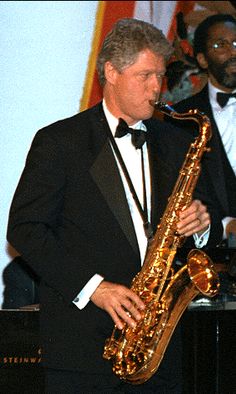
Bill Clinton riffin' more skillfully than I ever did on a tenor sax.
Both Bill and my dad came from Arkansas. 
I worked on my timing, and occasionally got it right. But not all the time. Then I found a solution to the problem, based on my father’s lesson in the French synagogue. I decided to follow the lead of someone in the know. As I played my solo, I would look over at the trombone player, and as soon as he rose to start playing his solo, I would stop mine. I might not have hit all of the notes in my solo, but I didn’t throw his or anyone else’s timing off. We were all happy, with the possible exception of the band director, but he was long suffering—which is all part of the job description of any high school instructor, as I would learn a few years later when I embarked on a brief high school teaching career of my own.  

Friday, July 8, 2016

A Dylan-esque Evening

"Good and bad, I define these terms
Quite clear, no doubt, somehow
But I was so much older then
I’m younger than that now."
            --Bob Dylan, My Back Pages

Back in my freshman year in college—when I was so much younger then—I decided not to take the time or spend the money to attend two concerts in downtown New Haven. One featured a young singer with an ethereal high-pitched voice named Joni Mitchell performing with an old veteran with a gravelly voice named Tom Rush. I’ll bet they were great that night. I can’t be sure because I wasn’t there. The second concert gained a certain amount of fame or infamy when singer Jim Morrison of The Doors went on a cursing binge and threatened to throw a microphone from the stage into the audience, leading to his becoming the first rock star to be arrested onstage. I missed that one too, and I still have regrets. Many years later, I did visit Morrison’s grave in Pere Lachaise cemetery in Paris, but that didn’t do much to ease my regrets about missing the concert.
Jim Morrison made history, and I missed it.
Flash forward a lot of years to last weekend when Audrey and I and our friends Helaine and Ken went to see our first Bob Dylan concert, even though Dylan has been around a lot of years. This time, my regret is that I WAS there.

Now, some people love Bob Dylan, and some people hate him, or at least his singing voice. I am in the former group. I have really liked Dylan the songwriter AND the singer over the years and have appreciated most of his many incarnations, with the possible exception of his “born again Christian” period (think” “You Gotta Serve Somebody”). Until now. The aging, rather than ageless, Dylan has decided to record parts of what music historians call, “the Great American Songbook.” On his latest album, he does Dylan-esque versions of some terrific standards such as “Come Rain or Come Shine” and “Young at Heart.” But he also throws in a real zinger in “Polka Dots and Moonbeams.” Yep, Bob Dylan, the rebellious folk-rock pioneer is singing about polka dots and moonbeams! It’s not as charming as it sounds.

Which brings me to last week’s concert at Tanglewood in the Berkshires in western Massachusetts. Before Dylan came on stage, we were entertained by Mavis Staples, who is around the same age as Dylan but a lot less cranky. Mavis charmed the audience and even got us all singing along in a 10-minuite version of “I’ll Take You There.” We sang only the same four words over and over, but we did it enthusiastically, and she seemed to really enjoy singing with us.

Mavis takes us there.
Then Mavis walked offstage to a rousing ovation, and Dylan came on just a few minutes later to an even louder welcome. He said nothing to the audience. Literally, nothing. Not “hello”, not “hi there,” not “hello Tanglewood,” He immediately broke into song. Now, we were on the lawn at Tanglewood a long way from the stage, but Dylan didn’t seem to be making eye contact even with those in the front rows. The only non-song words he spoke to the audience the whole evening came just before intermission, when he said, “We’ll be back in a few minutes.” Audrey turned to me and said, “The man is 75, he probably has to pee and figures he has to say something.”

Dylan performing in his own world
The second half of the program featured mostly Great American Songbook numbers sung in a strained voice, though Dylan did deliver almost unrecognizable versions of “Tangled Up in Blue” and “Blowin’ in the Wind.” Those songs upset me most of all. They were sung with little emotion and didn’t echo any of the bite or the irony of the originals. Even the amazing Dylan rhymes seemed to get lost. I felt that Dylan was saying, “These are my songs, not yours, and I’ll deliver them however I want.” Of course, he has the right to think that way, but we in the audience deserve a little more recognition. The concert ended soon afterward, without any comment from the performer. The lights simply came on, and we got up to leave. I’m not sure just what I expected from my evening with Bob Dylan, but it was more than I got.

The Dylan concert was our third live performance this year with an American icon in his or her 70s. A few months ago, we helped celebrate Joan Baez’s 75th birthday at the Beacon Theater in New York and attended one of the final performances of Garrison Keillor’s “Prairie Home Companion” at City Center in New York. Joan and Garrison developed a warm rapport with the audience and seemed to really enjoy what they were doing. And we loved being there with them. No true Dylan fan would expect him to be as upbeat as Joan Baez or as amusing as Garrison Keillor. But we have walked down a lot of roads with him since the mid-1960s and lived through a lot of changing times and styles with him. I wish he had just acknowledged that we were there then and now.
 
Garrison Keillor weaving a story
 
 
Joan and Judy together on Joan's birthday