-->

Monday, January 14, 2019


Gone but Not Forgotten

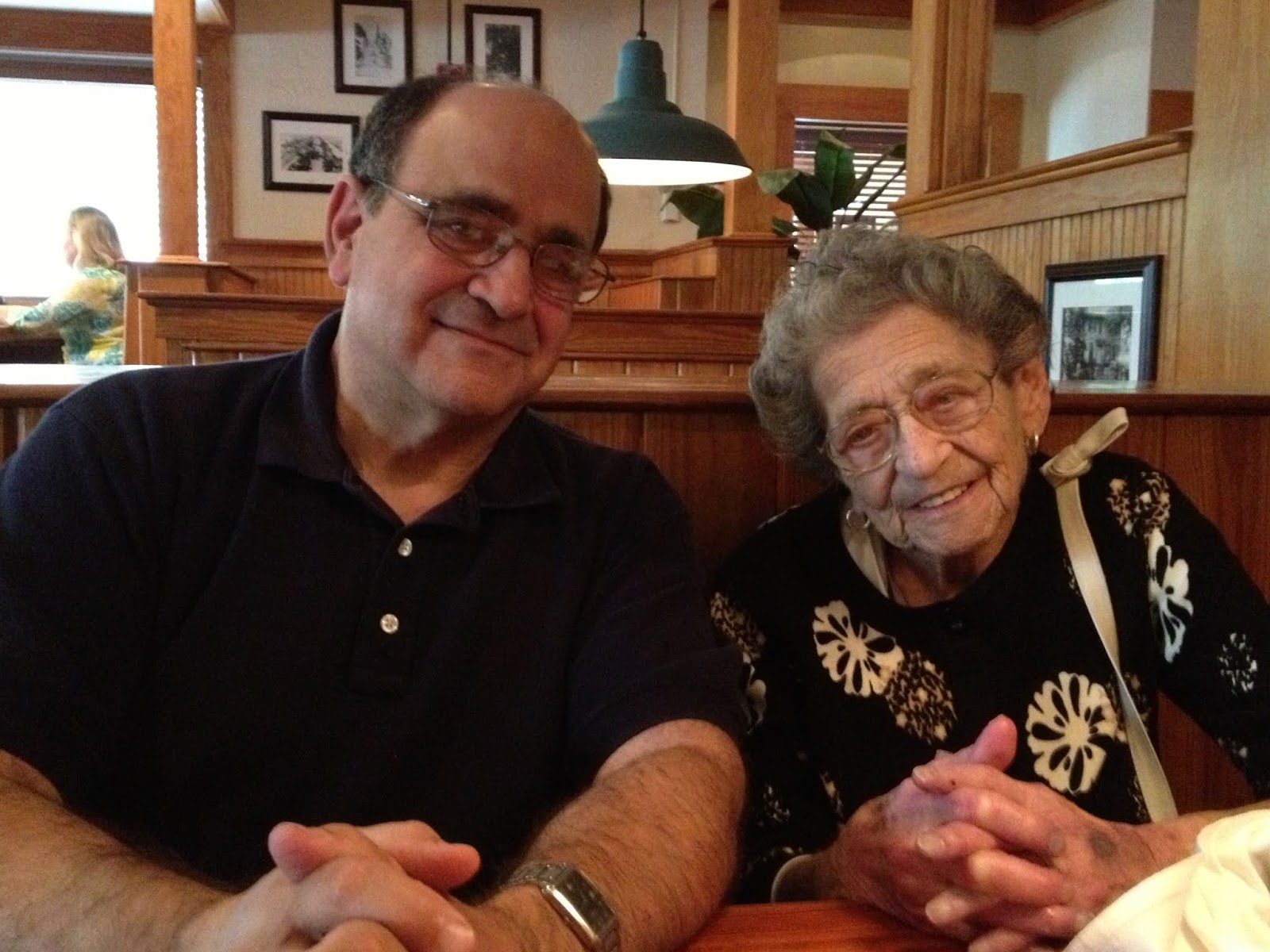
For both Audrey and me, our mothers have been showing up in unusual ways lately. “Showing up” may be overstating the situation. They haven’t exactly been making an appearance because sadly both died many years ago —more than 10 years ago in my mother-in-law’s case, and nearly five years ago in my mother’s. We remember them fondly still. In fact, Audrey reminded me this morning that today was her mother’s birthday. She would have been 104, which would have required a very large cake to celebrate properly. And a lot of breath to blow out the candles.


Audrey and her mom at her 90th birthday party
But we are not the only ones remembering Frances Katzenstein this week. A few days ago, we received the latest issue of the AARP newsletter in the mail. It came with a printed sticker attached, informing the recipient that her (or his) yearly membership payment was overdue and warning that this might be the last newsletter sent out until those dues were paid. It took me a few seconds to realize that the warning wasn’t for me (I am paid up as far as AARP goes), but for Frances Katzenstein, the seeming procrastinator, whose mail we had forwarded to our home soon after she died. The newsletter was followed up the next day with a “please renew your- membership” mailing to the same woman. I can’t be sure, but I suspect that my mother-in-law has been receiving those warnings and exhortations posthumously for many years without our taking notice. No one has sent a note to AARP to let them know just what is going on, and they haven’t made any effort to follow through on their threat to cut off her communications. Is there a statute of limitations on AARP dues delinquency, I wonder?

AARP is not the only ones communicating with the deceased in our family or facilitating communications with the deceased. For reasons that we don’t fully understand, starting a few weeks ago, when we receive a call from my brother and sister-in-law in Savannah, our caller ID robot says, “Call from Beatrice Goodman” while showing my brother’s phone number. What is Beatrice Goodman doing making calls using their phone number? And how is she doing it? And is the phone company planning to bill her? If so, I fear they will be no more successful than AARP in receiving payment.
My mom and me in Savannah six years ago
Neither of these wonderful women is a dead beat nor a ghost. They are simply deceased. I guess it’s nice to know that even though they are gone, they are not forgotten— neither by their children and grandchildren nor by assorted others who just don’t want to let go.
 

Friday, October 19, 2018


I Want to Hold Your Hand

I have just finished writing the manuscript for a new book for middle school kids on the World Refugee Crisis. It’s filled with scary numbers—such as the fact that 1 of every 118 people in the world today has been forced to flee from their family homes because of war, political unrest, or religious persecution. Not to mention natural disasters.

But what really drives most of these 68.5 million people to choose to flee rather than stay home is the overwhelming sense of chaos and disorder that surrounds them at home. They are looking for the same thing—a feeling of safety and security. There is a lot of research about basic human needs. I wonder how high on the list feeling safe and secure ranks.

The need for security is demonstrated in so many ways. My new favorite way is when our rabbi’s two-year-old daughter places her hand in mine in synagogue to help her balance during a climb up stairs or just to hold on when she is feeling a little shaky. Of course, mine is just a surrogate hand when her mom’s is occupied, but I like the feeling, and I think she does too. My children are far from hand-holding age any more, but I can still remember when they would willingly take my hand to cross a street or to protect them when they entered an unfamiliar place. It made us both feel more secure.

Little hands, big hands
On the opposite end in the human life cycle is “fear of falling” that aging adults and their highly concerned children experience. Literally losing balance seems truly frightening to me. As I get older, that is more on my mind. Wearing a fall alert necklace or bracelet can bring help, but I’m not sure it assures a feeling of safety for the potential faller. Just in case, I have been working regularly with a trainer at my gym who specializes in us older trainees. I asked him once why we spend so much time focusing on balance. “To make sure you keep getting up and staying up,” he explained. So I’m bending and stretching. Remember the Romper Room lady who urged us to “bend and stretch, reach for the sky”? My reach is a lot more limited, but maybe soon I’ll be able to touch the floor at least.

It’s not just people who have a need to feel safe and secure. Our dog Tess walks pretty well off the leash. She wanders around a little bit and sometimes seems aimless, sniffing everything in her path. But luckily she never takes off on her own journey. When I do take charge and clip on Tess’s leash, she seems to pep up and there is aim in her step. Maybe she is just following my aim, but I like to think that we both are happier and more secure.

Tess on a not-so-tight leash
Tess’s behavior differs from that of our first dog Seymour, also a solid black Scottie, who often took off to look for female companionship, or so we surmise. He almost always returned on his own, though he often seemed just a little tired from his amorous adventures. He came to a tragic end on a dark night in a dark street.  It may be significant that Tess has been crate-trained, and Seymour was not. On gloomy days or especially when there is thunder in the air, Tess often beds down in her crate to wait for sunnier or quieter times. Loud noises also drive her inside. The crate door is open, but she feels safe and secure staying inside.

I came across a website recently that urged all of us to embrace the chaos. One of the 12 reasons that most appealed to me was “so that you will become a better person…faster, stronger, leaner and sharper.” I would settle for leaner at least.

The site also led me to a quote that may have come from the Buddha himself: “The mind is like water,” he said. “When it's turbulent, it's difficult to see. When it's calm, everything becomes clear.”

So maybe what we are looking for isn’t only safety but calmness and clarity as well. And maybe that’s what the Beatles were singing about when they said, “Yeah, you got that somethin' . . . I think you'll understand . . .; When I say that somethin' . . .I want to hold your hand.”


Thursday, June 28, 2018


Body and Soul

When I was growing up, I lived in a Reader’s Digest home. We were middle class, literate, and apt to share with each other stories of what we found funny or touching in our everyday lives. We not only fit the Reader's Digest characteristics, we also subscribed. There were always several copies of the magazine lying around on tables in our den and even volumes of Reader’s Digest Condensed Books on our shelves or coffee table. My mother particularly loved the magazine, which came to our house 10 times a year and was a great source of a wide range of informative or helpful articles and short, funny stories from real life, such as this one:

We rushed our four-year-old son, Ben, to the emergency room with a terrible cough, high fever, and vomiting. The doctor did an exam, then asked Ben what bothered him the most. After thinking it over, Ben said hoarsely, "My little sister."

Perhaps my favorite regular feature was the occasional essays from readers submitted under the heading:  “My Most Unforgettable Character.” I even determined whom I would write about if I decided to submit my own Reader’s Digest essay. It was an easy choice—a Savannahian named Jack Berliner. I visited Jack several times a year at his house on 56th Street. He was the best listener and sharer I have ever met.

I don’t remember just how I felt during my first visit with Jack, though I can imagine that I was both nervous and a little frightened. I had been filled in on some of his back story before going with my father or older brother to his house. Here’s what I was told:

When Jack was 18, he was a counselor at the Jewish Educational Alliance Day Camp. He was practicing some tumbling in the exercise room, missed the mat, and suffered a horrific fall, breaking his neck. He lost the use of his legs and torso and went through endless surgeries and rehabilitation to regain the use of his arms and shoulders. Now he lived at home with his older brother Sam, who ran a candy-vending business. Jack made a living by selling magazine subscriptions and stationery supplies on the phone. But he made a life by talking to any visitors who showed up on his doorstep, and there were lots of us. He doled out philosophy and politics and positivity to all comers.

I learned quickly during that first visit and many others that followed that while so much of Jack was broken, what really mattered—his mind, mouth, ears, and heart—were intact and very much alive. He was a voracious reader, and could talk knowledgeably on any subject you might bring up.

Jack’s brother Sam (whom my cousin Richard once described as deserving of sainthood) met us at the door and led us to the bedroom where Jack held court in a large hospital bed. A bar was suspended from the ceiling above Jack’s chest. He would often link his elbows onto the bar to lift himself up and shift his position in the bed in order to get in a more comfortable spot to carry on our conversation. He never stopped talking or listening. A headset lay on his chest to be used for occasional sales calls and a burning cigarette in a holder stuck out from between his teeth. Sam spent almost too much time filling and emptying the cigarette holder, lighting up the cigarettes, or tapping ashes into an ashtray before they fell off by themselves onto the bedsheets. Watching those ashes and wondering if Sam would catch them in time could be hypnotic.

Jack's cigarette ash could have an hypnotic effect.
I can’t recall just what we talked about during our visits, but I know that I always felt better when I left the Berliner house than when I arrived. Jack had opinions, but he didn’t make judgments. Long before Bill O’Reilly came along, Jack Berliner established the original “no-spin zone.” You could share truths with him in confidence. What is so rare as that! I wish that all of us could have had a Jack Berliner in our lives.

I would visit Jack when I came back to Savannah from college into the early 1970s. Then I moved up North and seldom saw him again. In 1979, my mother gave me the sad news that Jack had died while going through another surgery. He was 49 years old, and had spent 30 of those years living outside of his broken body and embracing all of us who entered his sphere.

I had not thought of Jack for many years until I read last week about the impending and eventual death of Charles Krauthammer, who doled out wisdom for more than 40 years while confined to a wheelchair after a freak accident while diving into a pool at college. I have heard Krauthammer’s political pronouncements over the years and have not always (or even usually) agreed with him. But I honor his courage and his spirit, as well as his brilliance. They are so reminiscent of Jack’s. Neither man would let you feel sorry for their impediments. They both strove to make the world a better place, and we were better for having spoken with or listened to them.

Charles Krauthammer was a master of words and chess moves.
Regrettably, I never wrote that unforgettable character essay for Reader’s Digest. This blogpost  and my lasting memory will have to do.